Biover Labs · November 5, 2026 · 3 min read
What Is MOTS-c? A Mitochondrial-Derived Peptide Explained
A plain-English look at MOTS-c, a short mitochondrial-DNA peptide studied in laboratory energy-metabolism research, and how research material is checked. Research use only.
For laboratory and research use only. Not for human or veterinary consumption.
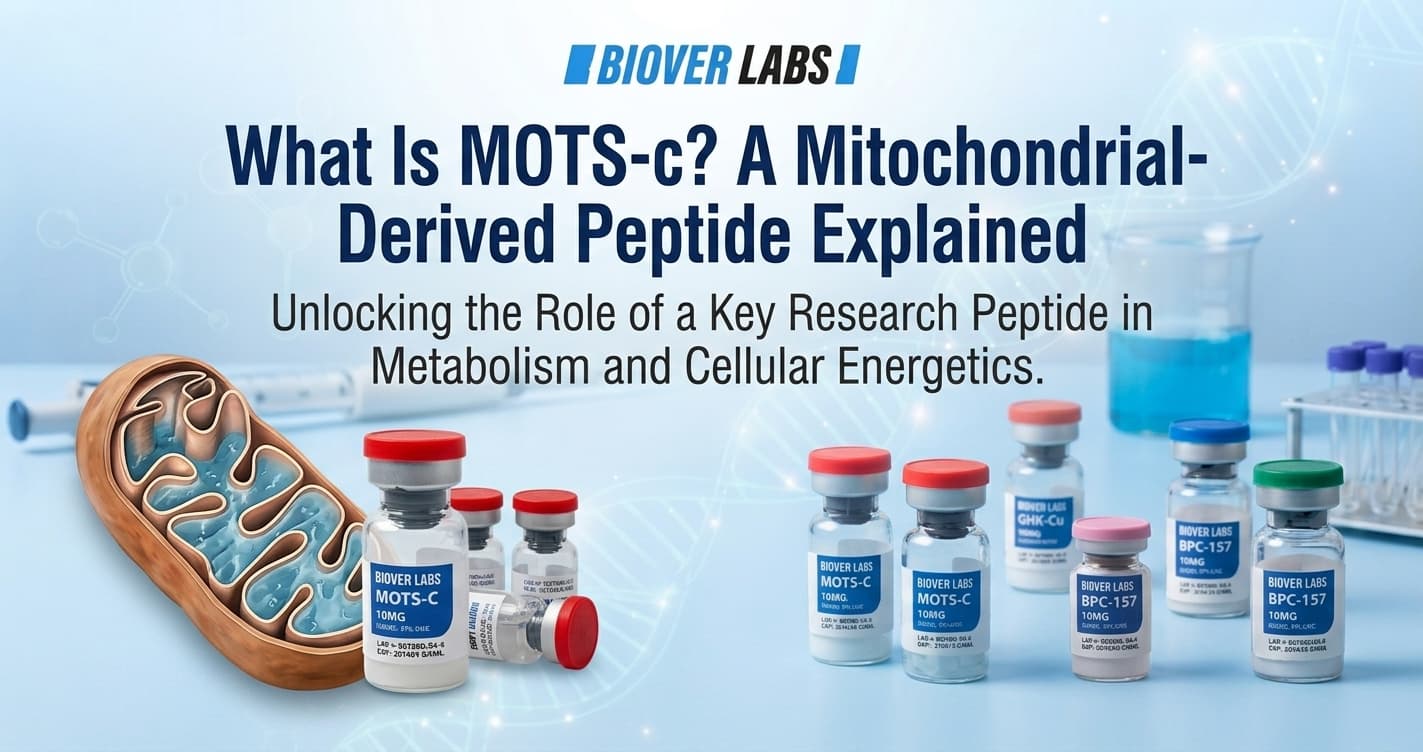
MOTS-c is a short peptide encoded in mitochondrial DNA. It belongs to a small class called mitochondrial-derived peptides, and laboratories study it mainly in cell and animal models of energy metabolism. This article answers what is MOTS-c, then covers the research focus and how to judge a research-grade sample.
What is MOTS-c?
The name stands for "mitochondrial open reading frame of the 12S rRNA type-c." That is a mouthful, but it tells you where the peptide comes from. Most proteins are built from instructions in the nucleus. MOTS-c is different: its sequence sits inside the mitochondrial gene for 12S ribosomal RNA.
It is a very small molecule, 16 amino acids long. If the terms are new, our plain-English peptide primer covers how amino acids link into peptides and why length matters.
Mitochondrial-derived peptides as a class
MOTS-c is one of several peptides reported to originate from mitochondrial DNA. The category interests researchers because it points to mitochondria as a possible source of signaling molecules, not only a site of energy production. Much of this work is still being developed.
What do laboratories study it for?
Researchers have studied MOTS-c in cell and animal models of cellular energy metabolism, including the AMPK pathway.
These are research questions, not established outcomes. Results from cell culture and animal models do not translate into claims about people, and nothing here should be read that way. If you are exploring this area of the catalog, the Metabolic Research category groups related materials.
Handling MOTS-c as a lyophilized research material
Like most research peptides, MOTS-c is typically supplied as a freeze-dried powder. Lyophilization removes water gently, which slows the hydrolysis and oxidation that degrade peptides in solution. Our guide to why peptides come as a powder explains the process.
General lab practice for any lyophilized peptide: keep it sealed, protected from light and moisture, and stored cold per the supplier's specification. Once a peptide is in solution its stability window shrinks, so labs plan batches to avoid long holding times. Always follow your institution's own protocols and the documentation shipped with the material.
How to check material quality
A peptide is only useful to a researcher if it is what the label says. Three checks answer that:
| Check | What it tells you |
|---|---|
| HPLC purity | The share of the sample that is the target peptide versus related impurities |
| Mass spectrometry | Whether the molecular weight matches the expected sequence (identity) |
| Certificate of Analysis | The documented results for a specific batch |
Read the HPLC trace, not just the headline percentage: one dominant peak with a clean baseline is what you want to see. Our explainer on how peptide purity gets measured walks through reading a chromatogram, and what a certificate of analysis contains shows what to look for in the paperwork.
For context on independent testing: the site currently shows an average purity of 98.77% across 66 independently tested batches, and a COA is provided with orders. You can see how that documentation is presented on our COA page, and the MOTS-c product page lists specifications for the research material.
Bottom line
MOTS-c is a 16-amino-acid peptide encoded in mitochondrial DNA, studied in cell and animal models for its relationship to cellular energy signaling. Good research with it starts with verified identity and purity, careful handling of the lyophilized powder, and a batch-specific COA.
All materials referenced are sold for laboratory and research use only. They are not drugs, supplements, or cosmetics, are not evaluated or approved by the FDA, and are not intended for human or veterinary consumption.