Biover Labs · November 2, 2026 · 3 min read
Bacteriostatic Water vs Sterile Water Explained
Both are sterile water, but only one carries a preservative. Here is what separates the two diluents and why it matters when handling lyophilized research materials.
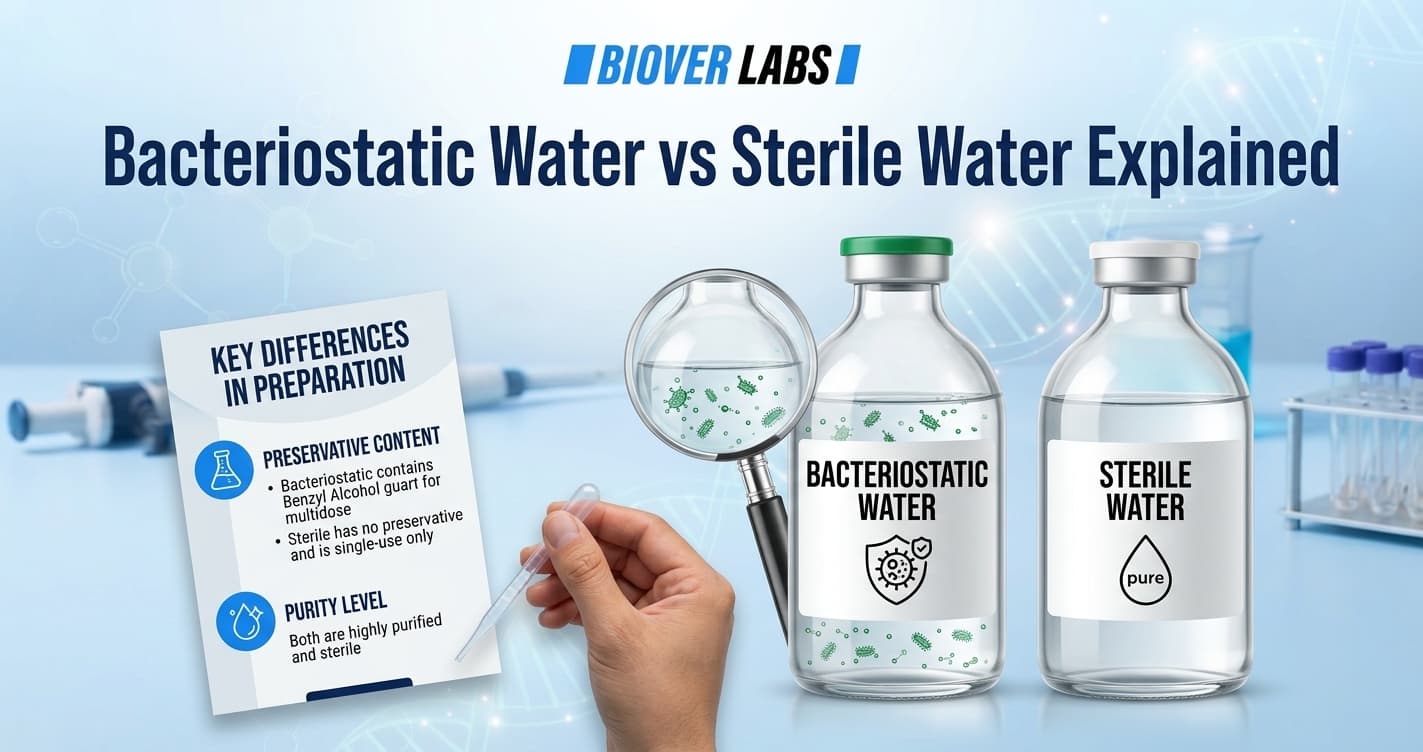
Bacteriostatic water vs sterile water comes down to one added ingredient. Sterile water contains nothing but water and is intended for single use once opened. Bacteriostatic water is sterile water with 0.9% benzyl alcohol added as a preservative, which lets a vial be entered more than once in a laboratory setting. USP monographs define both, and they are the reference to check for exact definitions and container limits.
This article is general laboratory-materials information. The materials discussed here are for laboratory and research use only, and are not intended for human or veterinary consumption.
Bacteriostatic water vs sterile water: the key difference
| Sterile water | Bacteriostatic water | |
|---|---|---|
| Added preservative | None | 0.9% benzyl alcohol |
| Intended use pattern | Single entry, then discard | Multiple entries of the same vial |
| Kills microbes already present | No, it is simply sterile at fill | No, it only inhibits growth |
| Main consideration | No additive to interact with a sample | Benzyl alcohol may not suit every material |
Neither product is a disinfectant. Both start sterile. The difference is what happens after the stopper has been punctured.
What "bacteriostatic" actually means
The word is easy to misread. A bacteriostatic agent inhibits bacterial growth. It does not sterilize. A bactericidal agent kills organisms; a bacteriostatic one holds them in check.
In bacteriostatic water, that job belongs to benzyl alcohol, an aromatic alcohol used as a preservative in many multi-dose pharmaceutical products. At 0.9% it is meant to suppress growth of organisms that might be introduced by a needle passing through the stopper. It does not repair poor technique. A contaminated needle still contaminates the vial.
Sterile water: the single-use logic
Sterile water has no preservative, so nothing slows growth after the seal is broken. Any organism that enters the container can multiply freely. That is why it is treated as a single-use diluent and discarded after opening instead of being kept for later.
The upside is chemical simplicity. With no benzyl alcohol, there is no additive that could interact with a sensitive sample or confound an assay.
When the choice matters for lab materials
Three practical questions drive the choice, and they are about the materials, not about any procedure:
- Compatibility. Benzyl alcohol is a solvent-like additive. Some sensitive compounds and some downstream assays do not tolerate it, so a researcher should check their own method before choosing.
- Number of entries. A vial that will be accessed repeatedly is the case a preservative is designed for. A vial opened once is the case sterile water fits.
- Handling window. Preservative-containing diluents are designed for longer handling windows than preservative-free ones, but any stated day counts should come from the manufacturer's label or a cited source, not a rule of thumb.
For the full picture of what happens when a freeze-dried material meets a solvent, see our reconstitution guide. To understand why the material arrives as a powder in the first place, read what lyophilization is.
Sterility is not a one-time property
A sterile label describes the product at the moment it was filled and sealed. It says nothing about the vial three weeks later. Every puncture, every pause on the bench, and every storage swing is a chance for that status to change. A preservative reduces one risk, microbial growth, but it does not address others such as chemical degradation (see peptide stability and degradation) or endotoxin carried in from earlier steps (see endotoxin and sterility testing).
This is also why documentation matters on the material side. A certificate of analysis records identity and purity for a specific batch, so a researcher knows what went into the vial before any diluent is chosen.
Bottom line
Choose by the material and the method, not by habit. Sterile water is the cleaner, simpler option for single-entry use. Bacteriostatic water trades some chemical simplicity for protection against growth when a vial must be entered repeatedly. Verify the details against the product label and the relevant USP monograph.
Bacteriostatic water is available as a laboratory consumable on the BAC water product page, and the full catalog is in the shop. Biover Labs provides a COA with orders, and all items are sold for laboratory research use only and have not been evaluated or approved by the FDA.
Image ideas
- Two vials side by side. Alt: "Two labeled laboratory diluent vials, one sterile water and one bacteriostatic water, on a clean bench." Neutral bench photo for the intro.
- Comparison diagram. Alt: "Simple diagram comparing sterile water with no additives and bacteriostatic water containing 0.9% benzyl alcohol." Flat graphic mirroring the table.
- Stopper inspection. Alt: "Researcher in gloves inspecting the rubber stopper of a sealed multi-dose vial." Supports the sterility section.
