Biover Labs · October 30, 2026 · 4 min read
Peptide Stability and Degradation Explained
Peptides break down through a handful of well-understood chemical routes, and temperature, moisture, light and pH decide how fast. Here is how degradation happens and how labs detect it in research materials.
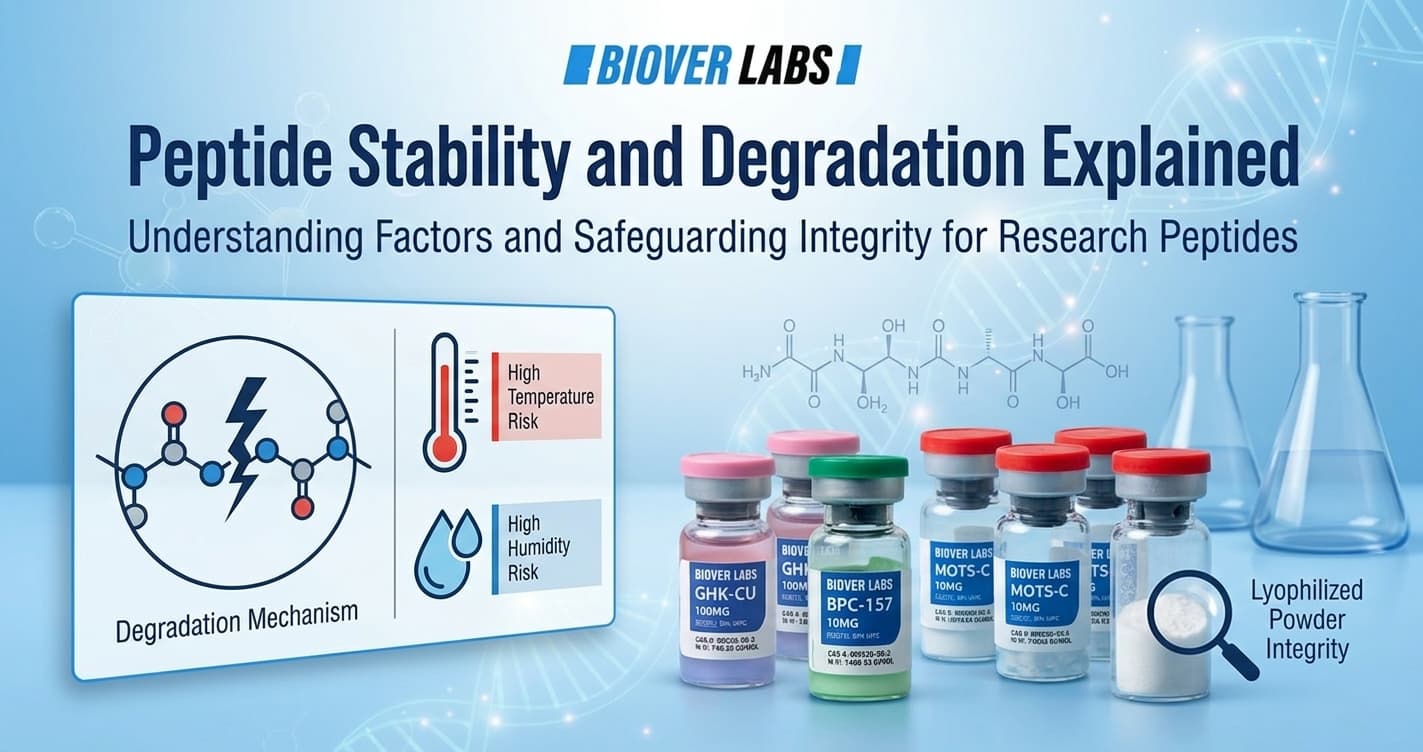
Peptide stability is how well a peptide keeps its intended structure and purity over time. In a research lab it is a practical question: if a vial sits on a shelf for months, is the material in it still the material on the label? The short answer is that peptides degrade through a few predictable chemical routes, and the rate depends mostly on temperature, moisture, light, pH and how often the material is thawed. Research peptides are for laboratory use only, not for human or veterinary consumption.
What "peptide stability" means in a lab
A peptide is a short chain of amino acids. Stability has two parts. Chemical stability means the bonds and side chains stay intact. Physical stability means the peptide does not clump, precipitate or stick to the vial wall. A sample can lose purity without any visible change, which is why labs measure it instead of judging by eye.
Shelf life is the period during which a material stays within its stated purity specification under defined storage conditions. It is not a fixed number for all peptides. A sequence rich in methionine behaves very differently from one without it.
Common degradation pathways
Four routes account for most losses:
- Oxidation. Methionine, cysteine and tryptophan side chains react with oxygen. Methionine picks up an oxygen atom, adding 16 Da to the mass.
- Deamidation. Asparagine (and, more slowly, glutamine) loses an amide group and becomes an acidic residue. Asparagine followed by glycine is a well-known weak spot.
- Hydrolysis. Water cleaves the backbone, often next to aspartic acid residues, producing shorter fragments.
- Aggregation. Peptide molecules associate into dimers, larger oligomers or insoluble particles.
Each route produces a distinct impurity, which is what makes them detectable.
Why lyophilized form is more stable than solution
Most of these reactions need water. Removing it slows them dramatically, which is the reason research peptides are usually supplied as a dry cake. We cover the process in what lyophilization is and why peptides come as a powder. Once a peptide is in solution, the clock speeds up; general handling is covered in our reconstitution guide.
Environmental factors
| Factor | What it does |
|---|---|
| Temperature | Higher temperature speeds nearly every reaction. Colder storage slows them. |
| Moisture | A lyophilized cake absorbs water from air. Even small amounts of moisture let hydrolysis and deamidation start. |
| Light | UV and strong visible light can damage tryptophan, tyrosine and other aromatic residues. |
| pH | Deamidation and hydrolysis run faster at extreme pH. Buffer choice matters in solution. |
| Freeze-thaw cycles | Repeated freezing and thawing can concentrate solutes, shift pH locally and drive aggregation. |
Moisture deserves extra attention. A cold vial opened in a warm room pulls condensation onto the powder, so labs let sealed vials reach room temperature before opening.
Transit is part of the picture too. Short excursions matter less for dry powder than for solutions, but temperature control still reduces risk; see cold-chain shipping for research peptides.
How degradation is detected
Labs rely on two core techniques and a paper trail.
- HPLC purity trend. High-performance liquid chromatography (what HPLC is) separates the main peptide from related impurities. A stability study runs the same method on samples at set time points. A shrinking main peak and growing side peaks show degradation. Reporting percent purity at each point turns "it looks fine" into a measurable trend.
- Mass spectrometry (MS). MS confirms identity and flags mass shifts. An extra 16 Da suggests oxidation. A shift of about 1 Da (+0.98) fits deamidation. Fragments at lower mass point to hydrolysis.
- The COA date. A Certificate of Analysis reports purity at the time of testing. A result from last year tells you about last year. When comparing a vial's age with its report, check the test date. See what a certificate of analysis is for how to read one.
Biover Labs provides a Certificate of Analysis with orders, and more detail is on the COA page.
General storage principles for research materials
These are principles, not protocols:
- Keep lyophilized material sealed, cold, dry and dark, and follow the storage conditions on the product documentation.
- Minimize time at room temperature and avoid repeated freeze-thaw cycles; labs commonly divide solutions into single-use aliquots to avoid them.
- Allow vials to equilibrate before opening to limit condensation.
- Record receipt date, opening date and storage conditions so purity data can be matched to real handling history.
- Re-verify purity by HPLC if material has been stored beyond its documented window or exposed to unusual conditions.
Bottom line
Peptide degradation is chemistry, not mystery: oxidation, deamidation, hydrolysis and aggregation, driven by heat, water, light, pH and freeze-thaw stress. Dry, cold, dark storage slows all of them, and HPLC plus mass spec show whether it worked. These materials are for laboratory research use only, are not a drug, supplement or cosmetic, and has not been evaluated or approved by the FDA. To compare compounds and their documentation, see the research catalog.
Image ideas
- Vial and thermometer. Lyophilized vial on a bench beside a storage thermometer. Alt: "Lyophilized research peptide vial on a laboratory bench next to a small storage thermometer."
- Pathway diagram. Clean four-panel graphic of oxidation, deamidation, hydrolysis and aggregation. Alt: "Simple diagram of four peptide degradation routes: oxidation, deamidation, hydrolysis and aggregation."
- Chromatogram comparison. Two overlaid HPLC traces, fresh versus aged. Alt: "HPLC chromatogram comparing a fresh peptide sample with an aged sample showing a new impurity peak."
