Biover Labs · October 27, 2026 · 4 min read
Peptide Endotoxin and Sterility Testing Explained
Endotoxin and sterility tests answer two separate questions about a research peptide batch. Here is how LAL, recombinant Factor C and USP <71> work, and how to read them on a COA.
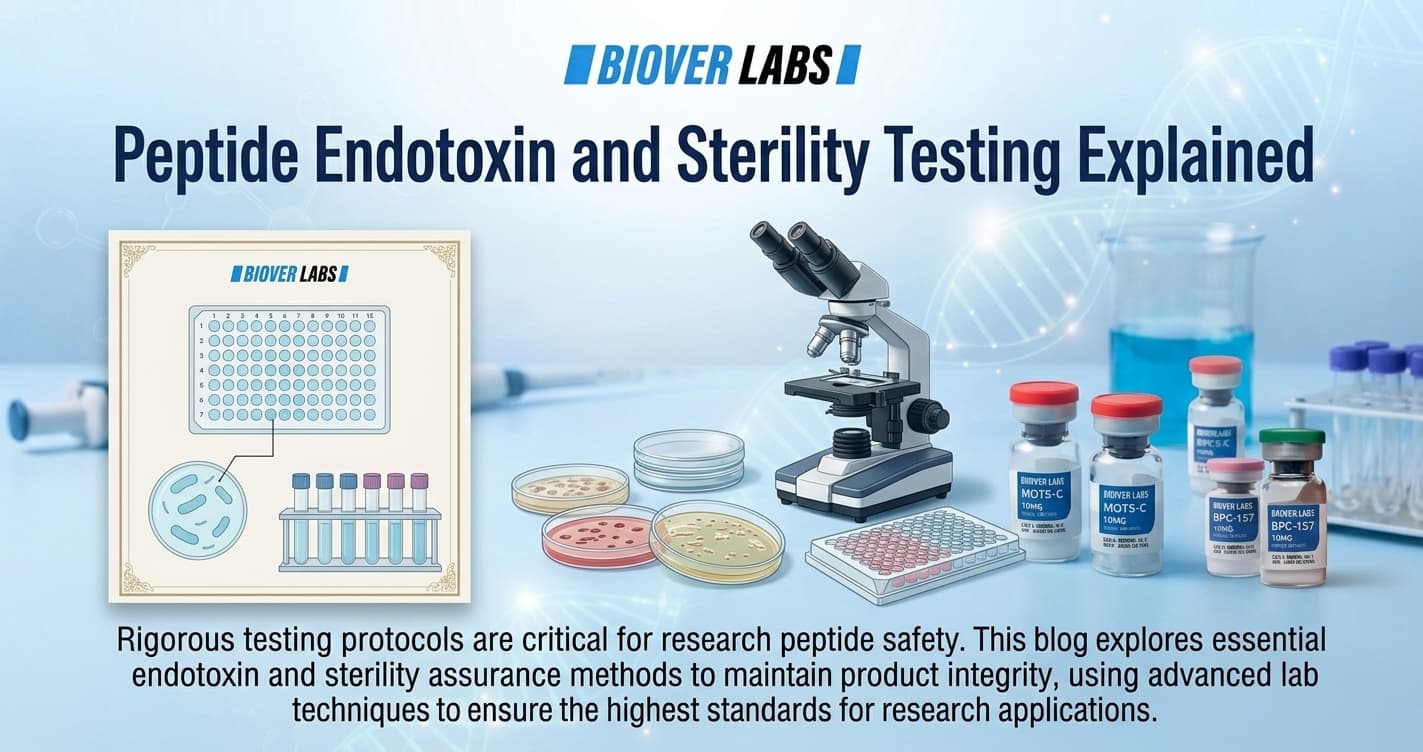
Peptide endotoxin testing measures bacterial debris left in a material. Sterility testing asks whether living microbes are present. A vial can pass one and fail the other, which is why a thorough report treats them as separate lines. This guide explains how each method works, what the units mean, and where the results appear on a certificate of analysis. All materials discussed are for laboratory and research use only.
Endotoxin vs sterility: two different questions
Endotoxin is lipopolysaccharide, a molecule from the outer membrane of Gram-negative bacteria. It is released when those cells die or break apart, and it is remarkably heat-stable. Autoclaving kills the organisms but does not reliably destroy it.
Endotoxin is a pyrogen, a substance that can trigger fever-type reactions in biological systems, which is why labs test for it. A sterile material can still carry it, because the bacteria that shed it are gone but their fragments are not. Conversely, a low-endotoxin result says nothing about live organisms.
- Endotoxin test (LAL or rFC): how much bacterial lipopolysaccharide is in the sample?
- Sterility test (USP <71>): does the sample contain viable microorganisms that grow in culture?
How peptide endotoxin testing works
Two assay families dominate.
LAL (Limulus amebocyte lysate)
LAL is an extract from the blood cells of horseshoe crabs. Endotoxin triggers a clotting cascade in the lysate, and the assay reads that cascade in one of three ways:
- Gel-clot: a visible clot forms at or above a set sensitivity. The readout is pass/fail at that level.
- Turbidimetric: the lysate turns cloudy, and the instrument tracks how fast.
- Chromogenic: the cascade releases a colored compound, and color intensity is measured.
Recombinant Factor C (rFC)
rFC assays use a lab-made version of the first enzyme in that cascade. It reacts to endotoxin with a fluorescent signal, without relying on animal-derived lysate. Many labs choose it for supply and sustainability reasons.
What EU/mL means
Results are reported in endotoxin units (EU), usually per mL of a solution or per mg of material. An EU is defined against a reference standard, not by mass, so it tells you activity rather than weight. Always read the unit: EU/mL and EU/mg are not interchangeable, and a number means little without the sample concentration and the limit the lab was testing against.
Peptides can also interfere with these assays. Some inhibit or enhance the reaction, so a credible method includes a spike recovery check: a known amount of endotoxin is added to the sample, and the lab confirms it can be detected.
How sterility testing works
The reference method most labs cite is USP <71>, "Sterility Tests." The concept is simple:
- The sample is introduced to growth media, either by membrane filtration or by direct inoculation.
- Two media types are used so both bacteria and fungi have a chance to grow: fluid thioglycollate medium and soybean-casein digest medium.
- Cultures are incubated, typically for 14 days, and checked for turbidity or other growth.
- No growth means the sample passes. Growth means it fails.
Because the test relies on organisms multiplying, it takes about two weeks and cannot be rushed. Controls matter here too: the lab should show that the media can support growth and that the sample itself does not suppress it.
Where these results appear on a COA, and where they do not
A basic certificate of analysis for a research peptide usually reports identity and purity: mass spectrometry confirms the molecular weight, and HPLC gives a purity percentage. Endotoxin and sterility lines are not universal. Many COAs simply do not include them, and absence of a line should be read as "not reported," not as "passed."
When you review any COA, look for:
- the test method named (LAL, rFC, USP <71>), not just "pass"
- the unit and the limit that applied
- the testing lab, the batch or lot number, and the date
Biover Labs provides a Certificate of Analysis with orders. See the COAs page for available certificates. For a walkthrough of the format, see our guide to what a certificate of analysis is.
Purity, identity, sterility and endotoxin compared
| Test | Question it answers | Typical method |
|---|---|---|
| Purity | What fraction of the material is the target peptide? | HPLC |
| Identity | Is the molecular weight what it should be? | LC-MS |
| Endotoxin | How much bacterial lipopolysaccharide is present? | LAL or rFC, reported in EU |
| Sterility | Does the sample support microbial growth? | USP <71> culture method |
No single line covers the others. A 99% HPLC purity figure does not speak to endotoxin or sterility, and a clean sterility result does not confirm identity.
Bottom line
Endotoxin and sterility testing are separate checks with separate methods, units and timelines. When a report includes them, look for the named method, the unit and the limit. When it does not, treat the question as unanswered rather than assumed.
Products in the shop are sold strictly for laboratory and research use only. They are not drugs or supplements, are not evaluated or approved by the FDA, and are not intended for human or veterinary consumption.
Image ideas
- Microplate assay: a gloved hand loading a 96-well plate. Alt: "Laboratory technician loading a microplate for a peptide endotoxin assay"
- Sterility cultures: rows of clear culture tubes in an incubator rack. Alt: "Sterility test culture tubes with clear growth media on a lab bench"
- COA close-up: a COA with result lines for HPLC, MS and endotoxin. Alt: "Close-up of a certificate of analysis showing HPLC, mass spectrometry and endotoxin result lines"
