Biover Labs · September 13, 2026 · 3 min read
Updated October 24, 2026
What Is Peptide Reconstitution? A Complete Guide
A lyophilized peptide is stable for years. Once it's reconstituted, the clock starts running. Here's what reconstitution actually involves, and why the solvent you pick matters.
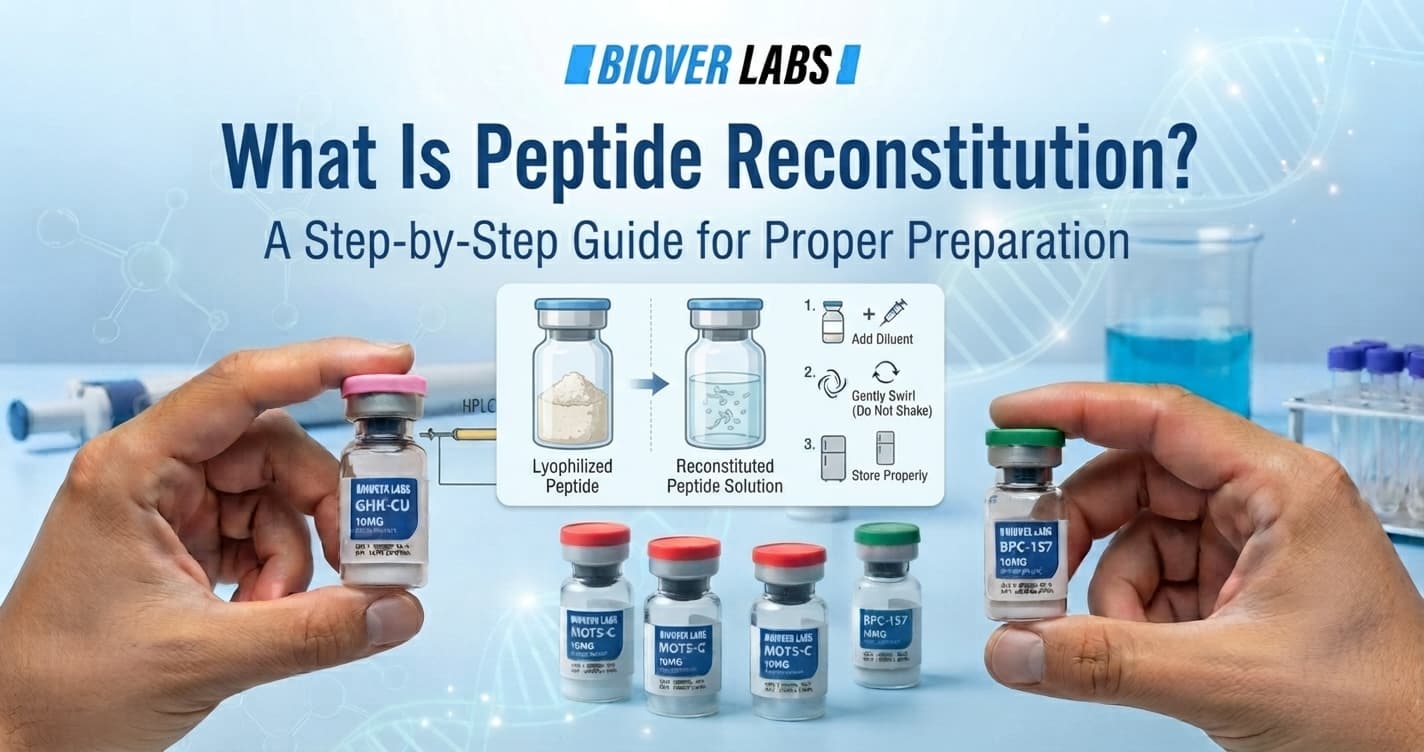
Reconstitution is the process of dissolving a lyophilized (freeze-dried) peptide back into a liquid, turning the stable powder sitting in a vial into a solution that can actually be used in a research setting. It sounds like a simple mixing step, and mechanically it is — but a few details matter more than people expect.
Why Peptides Ship as a Powder in the First Place
Lyophilization removes water from a peptide sample through freezing and vacuum-driven sublimation, producing a dry, stable cake. That dryness is what protects the peptide — most degradation pathways (hydrolysis, oxidation, aggregation) need a liquid environment to proceed at a meaningful rate. Remove the water, and you dramatically slow all of them down. A properly lyophilized peptide can remain stable for years. The moment it's reconstituted, it's back in a liquid environment, and the same degradation pathways start working against it again.
That's the whole reason reconstitution isn't just "add water and go" — how you do it affects how long the resulting solution stays usable.
Choosing a Solvent
Not every liquid is appropriate for reconstituting a peptide, and the choice depends on what the peptide is being used for.
- Bacteriostatic water — sterile water containing a small amount of benzyl alcohol as a preservative. This is the most common choice for peptides that will be stored for any length of time after reconstitution, since the preservative helps inhibit bacterial growth in the solution.
- Sterile water (without preservative) — used when benzyl alcohol isn't appropriate for the specific application, though the resulting solution generally needs to be used more quickly.
- Acetic acid solutions — occasionally used for peptides that are poorly soluble in plain water, particularly ones with hydrophobic sequences.
Using the wrong solvent, or water that isn't sterile, introduces contamination risk and can affect how well the peptide actually dissolves.
Reconstitution Ratios
The amount of solvent added determines the final concentration of the solution. A common approach: check the vial's peptide mass (for example, 5 mg), decide on a target concentration, and calculate the solvent volume from there. Adding 1 mL of bacteriostatic water to a 5 mg vial produces a 5 mg/mL solution; adding 2 mL produces 2.5 mg/mL, and so on.
There's no single "correct" ratio — it depends on the specific research application and what concentration is actually needed. What matters is getting the math right and being consistent, since an error here directly changes the effective concentration of every subsequent measurement taken from that vial.
How to Reconstitute Properly
- Let the vial reach room temperature before opening, to reduce condensation forming inside once it's unsealed.
- Using a syringe, draw the calculated volume of solvent.
- Inject the solvent slowly, aiming down the inside wall of the vial rather than directly onto the lyophilized powder — a direct, forceful stream can damage the peptide structure.
- Let the vial sit, then gently swirl (don't shake) until the powder is fully dissolved. Shaking can cause the peptide to aggregate or denature.
- Once dissolved, the solution should look clear. Cloudiness or visible particles usually indicate a problem — either a solubility issue with that specific peptide, or contamination.
Storage After Reconstitution
Once reconstituted, a peptide's shelf life drops dramatically compared to the lyophilized powder — typically from years down to a matter of days to a few weeks, and that window depends heavily on the specific compound and how it's stored. General practice:
- Refrigerate (2–8°C) the reconstituted solution; don't leave it at room temperature.
- Protect it from light if the peptide is light-sensitive.
- Avoid repeated freeze-thaw cycles, which can degrade the peptide faster than steady refrigeration.
The Bottom Line
Reconstitution is the step that turns a stable, lyophilized peptide into a usable solution — but it's also the step that starts the clock on degradation. Getting the solvent choice right, calculating the ratio carefully, and handling the vial gently during mixing all affect how reliable that solution stays over the following days and weeks. It's a simple process, but not one worth rushing.
